Sometimes, nature imitates human actions.
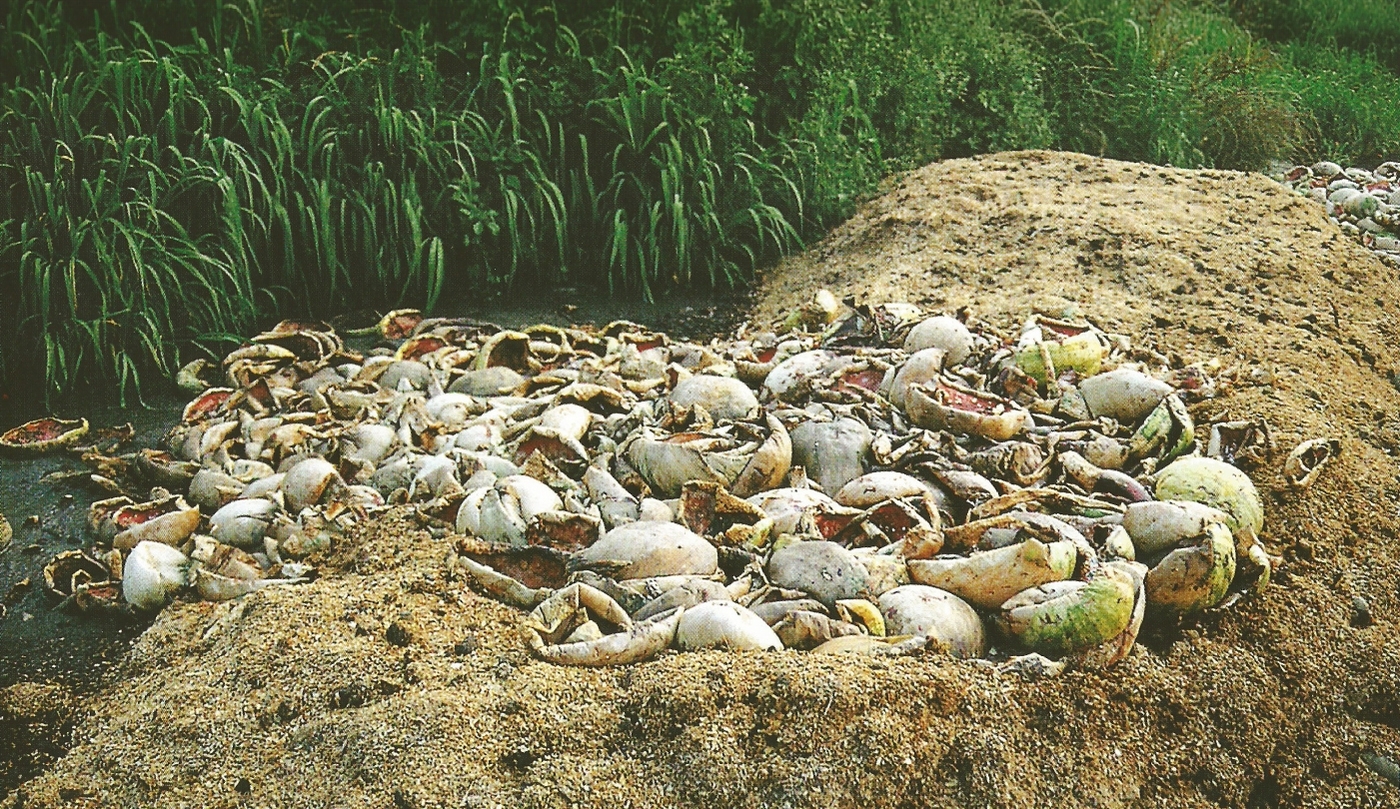
In this photograph, nature does not appear as the origin, but as the consequence. The pile of watermelon rinds – empty remains, lifeless bodies, shells deprived of their vital function – is arranged in space according to a logic that is neither random nor “natural” in the romantic sense of the term. It is a composition that recalls the human act of accumulation, discarding, and stratification of waste.
Here, nature seems to have learned the gesture of silent violence from man. The title reverses the classic mimetic idea: it is not man who imitates nature, but nature that reflects—like a distorting mirror—the predatory practices of human beings. The pile of shells thus becomes an involuntary sculpture, a monument to extraction, consumption and abandonment. There is no trace of the act that produced this scene, but its absence is eloquent: man is not present, yet he is everywhere.
The seemingly lush green landscape in the background offers no consolation. On the contrary, it accentuates the divide between the life cycle and the economic cycle. Organic matter does not return to the earth according to a biological cycle, but remains stuck in a dead, artificial cycle of exploitation. Nature, forced to “imitate”, loses its autonomy and becomes an archive of human faults.
The image acts as silent evidence: it does not openly denounce or sensationalise the disaster, but visually normalises it, as happens in everyday contemporary life. This is precisely why it is disturbing. It shows us a world in which the distinction between human action and natural processes has dissolved, leaving room for a grey area in which responsibility is diffuse but inescapable.
'Sometimes' - as the title suggests - not always. But that “sometimes” is enough to question our role:
if nature imitates man, then man has already crossed the line where imitation becomes condemnation.
Translated with DeepL
Sometimes, nature imitates human actions.
In this photograph, nature does not appear as the origin, but as the consequence. The pile of watermelon rinds – empty remains, lifeless bodies, shells deprived of their vital function – is arranged in space according to a logic that is neither random nor “natural” in the romantic sense of the term. It is a composition that recalls the human act of accumulation, discarding, and stratification of waste.
Here, nature seems to have learned the gesture of silent violence from man. The title reverses the classic mimetic idea: it is not man who imitates nature, but nature that reflects—like a distorting mirror—the predatory practices of human beings. The pile of shells thus becomes an involuntary sculpture, a monument to extraction, consumption and abandonment. There is no trace of the act that produced this scene, but its absence is eloquent: man is not present, yet he is everywhere.
The seemingly lush green landscape in the background offers no consolation. On the contrary, it accentuates the divide between the life cycle and the economic cycle. Organic matter does not return to the earth according to a biological cycle, but remains stuck in a dead, artificial cycle of exploitation. Nature, forced to “imitate”, loses its autonomy and becomes an archive of human faults.
The image acts as silent evidence: it does not openly denounce or sensationalise the disaster, but visually normalises it, as happens in everyday contemporary life. This is precisely why it is disturbing. It shows us a world in which the distinction between human action and natural processes has dissolved, leaving room for a grey area in which responsibility is diffuse but inescapable.
'Sometimes' - as the title suggests - not always. But that “sometimes” is enough to question our role:
if nature imitates man, then man has already crossed the line where imitation becomes condemnation.
Translated with DeepL




Contatti
nopavilion@gmail.com