This cleaning product, manufactured by a German company and called Negro, cannot be dismissed as mere commercial naivety or lexical residue. Rather, it is the concrete manifestation of an ideological continuity: the colonial legacy that survives in the language, images, and symbolic mechanisms of contemporary European society.
The term “negro” is not neutral, it is not historical, it is not innocent. It is a word laden with violence, constructed to create hierarchy, to reduce the other to a function, a useful body, a labour force, a tool of service.
In the context of a cleaning product, this word clearly reveals the racial mechanism that underpins it: black as dirt, as something to be removed, erased, subordinated to the civilising act of cleaning. The product does not merely clean surfaces, but enacts a symbolic cleansing: it reaffirms a worldview in which white purifies and black is associated with waste, fatigue, and marginality.
What is disturbing is not only the existence of this object, but its normalisation. The fact that it can circulate without scandal indicates how deeply rooted and accepted these mental structures still are. Racism here is not shouted, it is not explicit, but administered, industrial, silent. It is incorporated into design, marketing, and everyday life.
Exhibiting this object as a work of art or document means rejecting the aestheticisation of innocence. It means forcing the viewer to confront what they would rather not see: the persistence of colonial violence disguised as domestic functionality. Negro does not clean anything. On the contrary, it makes visible the ideological dirt that Europe has never really wanted to wash away.
Foto: Fabrizio Contarino
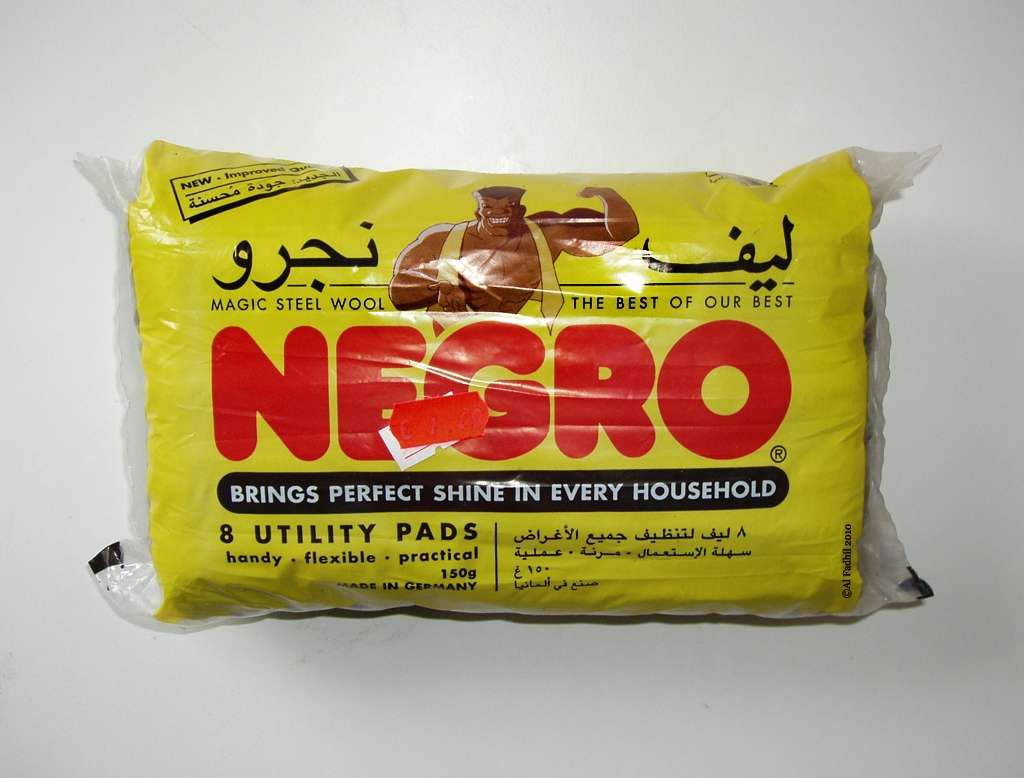
This cleaning product, manufactured by a German company and called Negro, cannot be dismissed as mere commercial naivety or lexical residue. Rather, it is the concrete manifestation of an ideological continuity: the colonial legacy that survives in the language, images, and symbolic mechanisms of contemporary European society.
The term “negro” is not neutral, it is not historical, it is not innocent. It is a word laden with violence, constructed to create hierarchy, to reduce the other to a function, a useful body, a labour force, a tool of service.
In the context of a cleaning product, this word clearly reveals the racial mechanism that underpins it: black as dirt, as something to be removed, erased, subordinated to the civilising act of cleaning. The product does not merely clean surfaces, but enacts a symbolic cleansing: it reaffirms a worldview in which white purifies and black is associated with waste, fatigue, and marginality.
What is disturbing is not only the existence of this object, but its normalisation. The fact that it can circulate without scandal indicates how deeply rooted and accepted these mental structures still are. Racism here is not shouted, it is not explicit, but administered, industrial, silent. It is incorporated into design, marketing, and everyday life.
Exhibiting this object as a work of art or document means rejecting the aestheticisation of innocence. It means forcing the viewer to confront what they would rather not see: the persistence of colonial violence disguised as domestic functionality. Negro does not clean anything. On the contrary, it makes visible the ideological dirt that Europe has never really wanted to wash away.
Foto: Fabrizio Contarino




Contatti
nopavilion@gmail.com